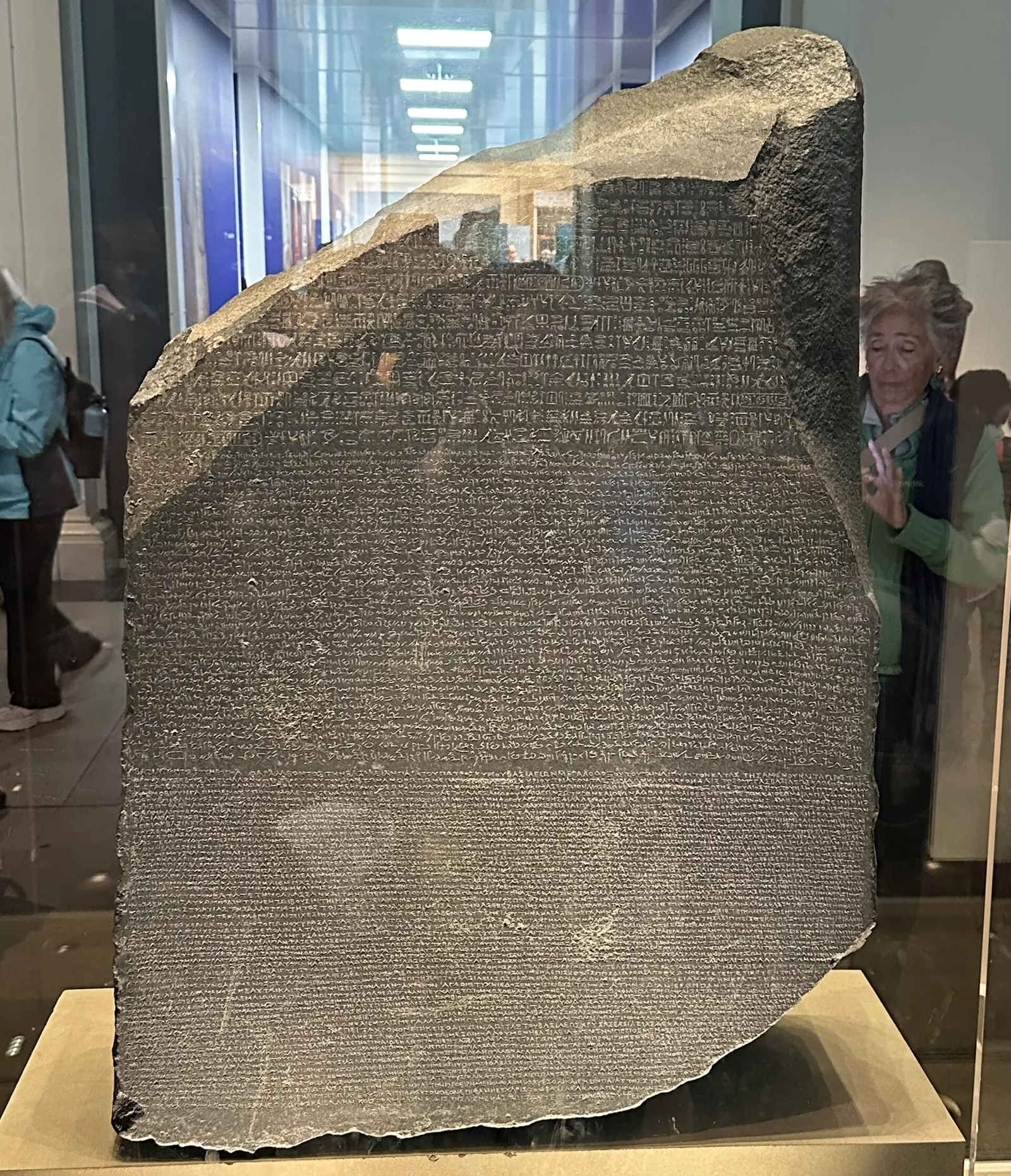
Read the Rosetta Stone as a monument of language, power, recovery and contested museum history—not merely the object that “decoded hieroglyphs”. The goal is not to exhaust the object, but to make the evidence, limits and museum choices easier to see.
CHAPTER 01
Before decipherment
The stone existed first as part of a decree, not as a modern linguistic puzzle. Its three scripts addressed different reading communities and institutional settings.
Begin with the physical record. Describe scale, edge, surface, joins and damage before turning those observations into a historical claim.
Object record
Record what is visible without filling missing context.
Material note
Connect technique to workshop decisions and available resources.
Context check
Restore the larger assemblage, site and ritual setting.
Museum question
Ask how display, caption and ownership frame the object today.
LOOK AGAINThe stone existed first as part of a decree, not as a modern linguistic puzzle. Its three scripts addressed different reading communities and institutional settings. What detail on the object could support—or challenge—this interpretation?
A responsible note
The museum history belongs inside the object story. Location, attribution, restoration and ownership should be dated when they can change and qualified when the record remains incomplete.
- Separate stable context from current display information.
- Prefer an object record to an anonymous travel summary.
- Distinguish an original, reconstruction, replica and digital image.
- Keep contested interpretations visible.
CHAPTER 02
A decree in material form
Granodiorite, layout and repetition turned administration into a durable public statement. The object joins language to ceremony and royal legitimacy.
Begin with the physical record. Describe scale, edge, surface, joins and damage before turning those observations into a historical claim.
Object record
Record what is visible without filling missing context.
Material note
Connect technique to workshop decisions and available resources.
Context check
Restore the larger assemblage, site and ritual setting.
Museum question
Ask how display, caption and ownership frame the object today.
LOOK AGAINGranodiorite, layout and repetition turned administration into a durable public statement. The object joins language to ceremony and royal legitimacy. What detail on the object could support—or challenge—this interpretation?
A responsible note
The museum history belongs inside the object story. Location, attribution, restoration and ownership should be dated when they can change and qualified when the record remains incomplete.
- Separate stable context from current display information.
- Prefer an object record to an anonymous travel summary.
- Distinguish an original, reconstruction, replica and digital image.
- Keep contested interpretations visible.
CHAPTER 03
Three scripts
Hieroglyphic, Demotic and Greek are not decorative translations arranged for modern convenience. Their coexistence reveals political and cultural negotiation.
Begin with the physical record. Describe scale, edge, surface, joins and damage before turning those observations into a historical claim.
Object record
Record what is visible without filling missing context.
Material note
Connect technique to workshop decisions and available resources.
Context check
Restore the larger assemblage, site and ritual setting.
Museum question
Ask how display, caption and ownership frame the object today.
LOOK AGAINHieroglyphic, Demotic and Greek are not decorative translations arranged for modern convenience. Their coexistence reveals political and cultural negotiation. What detail on the object could support—or challenge—this interpretation?
A responsible note
The museum history belongs inside the object story. Location, attribution, restoration and ownership should be dated when they can change and qualified when the record remains incomplete.
- Separate stable context from current display information.
- Prefer an object record to an anonymous travel summary.
- Distinguish an original, reconstruction, replica and digital image.
- Keep contested interpretations visible.
CHAPTER 04
The work of decipherment
Decipherment was cumulative, international and competitive. A single heroic name cannot explain the networks of copies, comparisons and earlier scholarship.
Begin with the physical record. Describe scale, edge, surface, joins and damage before turning those observations into a historical claim.
Object record
Record what is visible without filling missing context.
Material note
Connect technique to workshop decisions and available resources.
Context check
Restore the larger assemblage, site and ritual setting.
Museum question
Ask how display, caption and ownership frame the object today.
LOOK AGAINDecipherment was cumulative, international and competitive. A single heroic name cannot explain the networks of copies, comparisons and earlier scholarship. What detail on the object could support—or challenge—this interpretation?
A responsible note
The museum history belongs inside the object story. Location, attribution, restoration and ownership should be dated when they can change and qualified when the record remains incomplete.
- Separate stable context from current display information.
- Prefer an object record to an anonymous travel summary.
- Distinguish an original, reconstruction, replica and digital image.
- Keep contested interpretations visible.
CHAPTER 05
From Rashid to London
Discovery, military transfer and collection history are part of the object’s biography. Provenance changes the questions a museum label must answer.
Begin with the physical record. Describe scale, edge, surface, joins and damage before turning those observations into a historical claim.
Object record
Record what is visible without filling missing context.
Material note
Connect technique to workshop decisions and available resources.
Context check
Restore the larger assemblage, site and ritual setting.
Museum question
Ask how display, caption and ownership frame the object today.
LOOK AGAINDiscovery, military transfer and collection history are part of the object’s biography. Provenance changes the questions a museum label must answer. What detail on the object could support—or challenge—this interpretation?
A responsible note
The museum history belongs inside the object story. Location, attribution, restoration and ownership should be dated when they can change and qualified when the record remains incomplete.
- Separate stable context from current display information.
- Prefer an object record to an anonymous travel summary.
- Distinguish an original, reconstruction, replica and digital image.
- Keep contested interpretations visible.
CHAPTER 06
What the icon hides
Its global fame can flatten the decree’s content and modern ownership debate. Slow looking restores scale, damage, surface and institutional context.
Begin with the physical record. Describe scale, edge, surface, joins and damage before turning those observations into a historical claim.
Object record
Record what is visible without filling missing context.
Material note
Connect technique to workshop decisions and available resources.
Context check
Restore the larger assemblage, site and ritual setting.
Museum question
Ask how display, caption and ownership frame the object today.
LOOK AGAINIts global fame can flatten the decree’s content and modern ownership debate. Slow looking restores scale, damage, surface and institutional context. What detail on the object could support—or challenge—this interpretation?
A responsible note
The museum history belongs inside the object story. Location, attribution, restoration and ownership should be dated when they can change and qualified when the record remains incomplete.
- Separate stable context from current display information.
- Prefer an object record to an anonymous travel summary.
- Distinguish an original, reconstruction, replica and digital image.
- Keep contested interpretations visible.
RESEARCH TRAIL
Where to continue
- Institutional collection record and object number.
- Published catalogue or conservation report.
- Archaeological context and provenance documentation.
- Image creator and reuse license.
Editorial review: 16 July 2026. This essay does not claim an unrecorded first-hand visit.