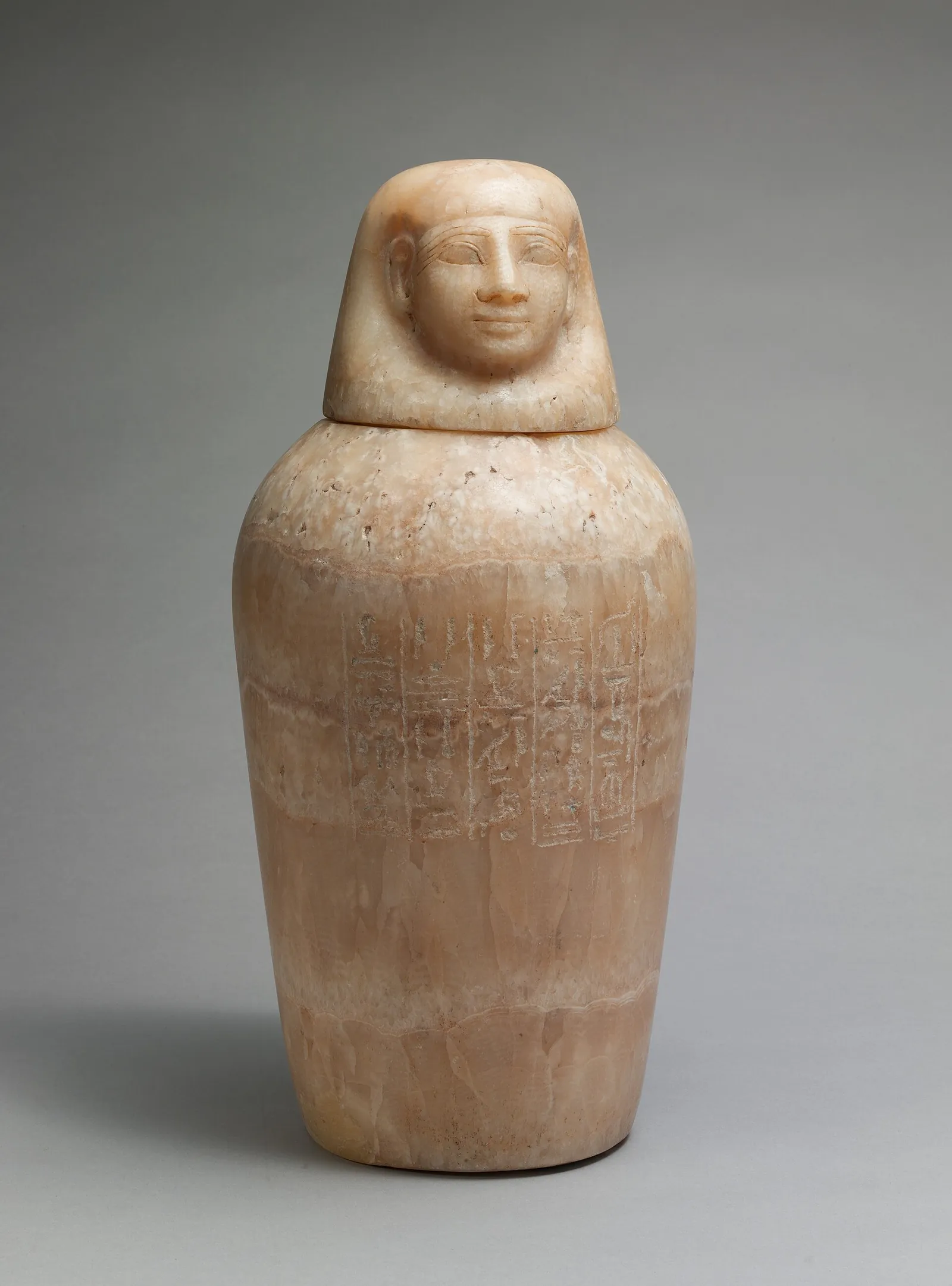
A vessel at the meeting point of embalming, personhood, divine protection and the museum’s tendency to isolate a set. The goal is not to exhaust the object, but to make the evidence, limits and museum choices easier to see.
CHAPTER 01
Part of a set
A single jar can be visually complete yet ritually incomplete. Sets, chests and associated burial equipment recover the larger system.
Begin with the physical record. Describe scale, edge, surface, joins and damage before turning those observations into a historical claim.
Object record
Record what is visible without filling missing context.
Material note
Connect technique to workshop decisions and available resources.
Context check
Restore the larger assemblage, site and ritual setting.
Museum question
Ask how display, caption and ownership frame the object today.
LOOK AGAINA single jar can be visually complete yet ritually incomplete. Sets, chests and associated burial equipment recover the larger system. What detail on the object could support—or challenge—this interpretation?
A responsible note
The museum history belongs inside the object story. Location, attribution, restoration and ownership should be dated when they can change and qualified when the record remains incomplete.
- Separate stable context from current display information.
- Prefer an object record to an anonymous travel summary.
- Distinguish an original, reconstruction, replica and digital image.
- Keep contested interpretations visible.
CHAPTER 02
Body and preservation
Embalming transformed the body through skilled physical and ritual work. Containers participated in that protected reassembly.
Begin with the physical record. Describe scale, edge, surface, joins and damage before turning those observations into a historical claim.
Object record
Record what is visible without filling missing context.
Material note
Connect technique to workshop decisions and available resources.
Context check
Restore the larger assemblage, site and ritual setting.
Museum question
Ask how display, caption and ownership frame the object today.
LOOK AGAINEmbalming transformed the body through skilled physical and ritual work. Containers participated in that protected reassembly. What detail on the object could support—or challenge—this interpretation?
A responsible note
The museum history belongs inside the object story. Location, attribution, restoration and ownership should be dated when they can change and qualified when the record remains incomplete.
- Separate stable context from current display information.
- Prefer an object record to an anonymous travel summary.
- Distinguish an original, reconstruction, replica and digital image.
- Keep contested interpretations visible.
CHAPTER 03
Lids and identities
Head forms and divine associations changed over time. Familiar textbook schemes should not be projected onto every period.
Begin with the physical record. Describe scale, edge, surface, joins and damage before turning those observations into a historical claim.
Object record
Record what is visible without filling missing context.
Material note
Connect technique to workshop decisions and available resources.
Context check
Restore the larger assemblage, site and ritual setting.
Museum question
Ask how display, caption and ownership frame the object today.
LOOK AGAINHead forms and divine associations changed over time. Familiar textbook schemes should not be projected onto every period. What detail on the object could support—or challenge—this interpretation?
A responsible note
The museum history belongs inside the object story. Location, attribution, restoration and ownership should be dated when they can change and qualified when the record remains incomplete.
- Separate stable context from current display information.
- Prefer an object record to an anonymous travel summary.
- Distinguish an original, reconstruction, replica and digital image.
- Keep contested interpretations visible.
CHAPTER 04
Stone as container
Hollowing, polishing and fitting a lid required precise work. Tool traces and internal surfaces can be as informative as the face.
Begin with the physical record. Describe scale, edge, surface, joins and damage before turning those observations into a historical claim.
Object record
Record what is visible without filling missing context.
Material note
Connect technique to workshop decisions and available resources.
Context check
Restore the larger assemblage, site and ritual setting.
Museum question
Ask how display, caption and ownership frame the object today.
LOOK AGAINHollowing, polishing and fitting a lid required precise work. Tool traces and internal surfaces can be as informative as the face. What detail on the object could support—or challenge—this interpretation?
A responsible note
The museum history belongs inside the object story. Location, attribution, restoration and ownership should be dated when they can change and qualified when the record remains incomplete.
- Separate stable context from current display information.
- Prefer an object record to an anonymous travel summary.
- Distinguish an original, reconstruction, replica and digital image.
- Keep contested interpretations visible.
CHAPTER 05
Names and ownership
Inscriptions may identify owner, deity and protective speech. Damage or replacement can complicate an apparently straightforward identity.
Begin with the physical record. Describe scale, edge, surface, joins and damage before turning those observations into a historical claim.
Object record
Record what is visible without filling missing context.
Material note
Connect technique to workshop decisions and available resources.
Context check
Restore the larger assemblage, site and ritual setting.
Museum question
Ask how display, caption and ownership frame the object today.
LOOK AGAINInscriptions may identify owner, deity and protective speech. Damage or replacement can complicate an apparently straightforward identity. What detail on the object could support—or challenge—this interpretation?
A responsible note
The museum history belongs inside the object story. Location, attribution, restoration and ownership should be dated when they can change and qualified when the record remains incomplete.
- Separate stable context from current display information.
- Prefer an object record to an anonymous travel summary.
- Distinguish an original, reconstruction, replica and digital image.
- Keep contested interpretations visible.
CHAPTER 06
Museum afterlives
Separated jars may be reconstructed into sets through style or provenance. Displays should distinguish evidence from modern matching.
Begin with the physical record. Describe scale, edge, surface, joins and damage before turning those observations into a historical claim.
Object record
Record what is visible without filling missing context.
Material note
Connect technique to workshop decisions and available resources.
Context check
Restore the larger assemblage, site and ritual setting.
Museum question
Ask how display, caption and ownership frame the object today.
LOOK AGAINSeparated jars may be reconstructed into sets through style or provenance. Displays should distinguish evidence from modern matching. What detail on the object could support—or challenge—this interpretation?
A responsible note
The museum history belongs inside the object story. Location, attribution, restoration and ownership should be dated when they can change and qualified when the record remains incomplete.
- Separate stable context from current display information.
- Prefer an object record to an anonymous travel summary.
- Distinguish an original, reconstruction, replica and digital image.
- Keep contested interpretations visible.
RESEARCH TRAIL
Where to continue
- Institutional collection record and object number.
- Published catalogue or conservation report.
- Archaeological context and provenance documentation.
- Image creator and reuse license.
Editorial review: 16 July 2026. This essay does not claim an unrecorded first-hand visit.